Sunday, August 17, 2014

The Fruit Explorer Encounters Dragon Fruit

To All,

I don't feel comfortable at Whole Foods because of its staggeringly high prices and its snooty atmosphere. Nevertheless, feeling that it was the Fruit Explorer's duty, several months ago I went to Whole Foods and found that they did not have any fruits outside the mainstream. This suited me fine; henceforth, I happily stayed away. Now, however, because Market Basket has taken the gas-pipe and, at least for now, removed itself from the land of the living, and also because of a tip from Robin, I went back to Whole Foods and, finding a variety of fruits, scored some dragon fruit.

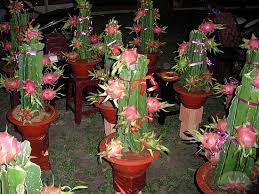
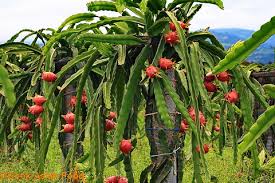
The eye-catching dragon fruit, with its armor plating and flourishes at the tip of each scale, looks like another living fossil from a prehistoric age; see the picture of my dragon fruit ripening on my window sill. The tips of the scales show better in the second picture, which is from the Internet. Despite this unearthly look, dragon fruit is in the cactus family; see the next two pictures. In fact, in size, shape, and coloring, the dragon fruit looks much like the cactus pear that I reported on. If you don't have a green thumb and are looking for something hardy that you can grow, maybe you should try this cactus.


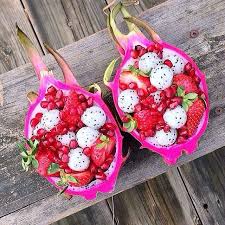
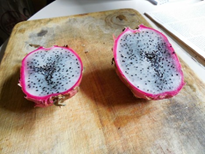
The Internet provided a video on how to eat dragon fruit at https://www.youtube.com/watch?v=ynRkdlpjl7E. All you do is cut it in half, scoop out the meat with a spoon, and cut it up however you like. Pictures below show my dragon fruit whole on my cutting board, cut in half, and with the fruit scooped out. This preparation was extremely quick and easy. The empty half-shells can serve as fruit cups; you can load the dragon fruit back into them after cutting it up. (The cutting board in these pictures is my primary cutting board, which you have not seen before; in the jack fruit pictures you saw my back-up cutting board.)


Now for the taste test. I took a big bite of dragon fruit and chewed it thoughtfully. The taste was just barely perceptible, and what taste there was hovered on the borderline between pleasant and unpleasant. It did have a nice texture provided by numerous small black seeds, reminiscent of poppy seeds. In short, the dragon fruit combines the size, shape, color, and taste of the cactus pear with the soft, scoopable-with-a-spoon fruit and the host of small black seeds of the kiwi. All that the dragon fruit contributes of its own is its funny exterior look and the ready-made fruit cups.

Of course, there are other ways to eat dragon fruit--as chips, a popsicle, or in Bacardi Dragon Berry, which is a rum drink described at http://www.bacardi.com/us/products/all-rums/bacardi-dragon-berry as having "...a unique blend of ripe juicy strawberries and sweet, exotic dragonfruit that creates a bold flavor that no other flavored spirit offers." If you don't like rum, you can have Dragon Fruit Vodka, or you can choose from a variety of soft drinks.


The verdict is that the appeal of dragon fruit is more visual than gustatory. With a price of $3.05 (remember, this is an inflated Whole Foods price) for a fruit the size of a medium pear, dragon fruit cannot be recommended as anything beyond a visual garnish.

Dragon fruit seems to be another fruit that the marketeers have gotten hold of. They have given it a flashy name (replacing "pitaya") and taken advantage of its striking exterior to try to hide the fact that for eating this is a very pedestrian fruit. (Remember not only that this verdict is based on a sample size of one but also that there are many species of dragon fruit that come from two genera in the cactus family.)

Your party tip takes advantage of dragon fruit's built-in fruit cup and visual appeal without making your guests eat an entire serving. Give each guest a scooped-out dragon fruit half to serve as a fruit cup and guide them to a fruit bar that offers diced fruits that you have learned about in these e-mails. Each guest can then build a fruit salad to his or her own taste. Use your new digital camera to take a picture of each guest along with his or her customized fruit salad. For women, before taking their picture allow them to slip into the dragon fruit princess dress. While your guests eat their fruit salad, print out each picture and stick it in a frame from the Dollar Store. You can then send each guest home with a never to be duplicated reminder of your party. As for the left-over dragon fruit, maybe your dog will eat it. Alternatively, use it to make candles.


The Fruit Explorer


Sunday, August 10, 2014

The Fruit Explorer Encounters Jack Fruit Seeds

To All,

When I butchered the jack fruit, I was so overwhelmed by the richness of the experience that I ignored the seeds. Even though I knew that they could be eaten and had drawn admiring comments from Internet experts, I couldn't spare any attention for them and threw them away so I could focus on the fruit proper. Each individual fruit held a seed, and as time passed and I ate fruits and handled the seeds, I noticed how handsome they were. I started to collect them and ended up with thirty-eight seeds, which weighed six ounces. (I figure that the entire jack fruit had maybe two hundred seeds.) It occurred to me that the proper way to complete my worship of the jack fruit was to eat its seeds. One picture below shows two seeds, with the one on the left unpeeled and the one on the right peeled, with a quarter for scale. The other picture shows my bowl of seeds.


I have never roasted, boiled, stewed, or otherwise cooked a seed or nut, so my ignorance of how to proceed was complete. Marvelous to relate, the Internet coughed up a cornucopia of recipes. In a sense, a jack fruit seed it like a little potato. Just as there are many ways to prepare a potato, there is almost endless choice of how to prepare jack fruit seeds. The essence of jack fruit seed cooking is that the seeds are hard, and to make them edible you need to cook them in some way until they are soft. I decided to try boiling, roasting, and stir-frying. The details of how I cooked them are in the appendix to this e-mail for those who are interested; here I will only cover the essentials.

The boiled jack fruit seeds really were like little boiled potatoes. I boiled them, mashed them, dressed them with salsa, and ate them. They were good; pretty much as potatoes would be but with a little more texture It was a nice change of pace to have such tiny potatoes. My attempts at roasting and stir-frying resulted in burning and ruining my seeds.

I estimate that my thirty-eight seeds, if not ruined in cooking, would yield about one and a half midnight snacks.

As seems inevitable, the Internet experts swoon over the nutritional properties of both jack fruit and its seeds.

The verdict: I like the seeds almost as much as the fruit. The drawback is that it takes about half an hour to cook them. This is a lot harder than downing a raw fruit.

Remember, jack fruit seeds are gluten-free.

But wait, there's more. The site http://www.stylecraze.com/articles/benefits-of-jackfruit-seeds-for-skin-hair-and-health/ details many more benefits that the knowing can reap from jack fruit seeds.
  • Fights wrinkles: "Take a seed of jackfruit and keep it dipped in cold milk for a while. Grind it well and apply softly on your wrinkles. It is believed to work on wrinkles in just about four-five weeks time. Apply regularly for best results."
  • Flawless complexion: "You just need to soak the dry seed with some milk and honey and grind it into a fine paste. Now apply this paste on your face evenly and let it dry completely. Wash it off to get a flawless skin within minutes."
  • Anti-cancer nutrients.
  • Comfort from indigestion. 
  • Promotes hair growth.
  • And more.
Fool that I am, like an animal I ate my jack fruit seeds instead of putting them to these higher uses. 

I invite my readers to apply a jack fruit seed beauty mask and to send a picture via Reply All.

After all this, you are probably asking how to grow jack fruit inside your home. The Internet never disappoints; go to http://houseplants.about.com/od/Easy_Plants/p/Jackfruit-how-To-Grow-Jackfruit-Indoors.htm  Plan on moving into a bigger house.

If you will be growing your own jack fruit, you will be interested in the properties of its wood. It is yellow with a pleasing grain and is coveted for furniture-making. Let's hope all the jack fruit trees don't all get cut down to make jewelry chests for rich people.

If you watched the video in the previous e-mail, you might have noticed that my machete was not quite long enough to conveniently cut the jack fruit even though this fruit was small by jack fruit standards. This means that to efficiently cut jack fruit, one needs a broadsword.

Here's your party tip. To your next party invite people from many lands. In advance give each person a supply of jack fruit seeds and ask him/her to prepare them as they are cooked in his/her native country and bring this dish to the party. Your guests will then feast on boiled jack fruit seeds, roasted jack fruit seeds, stir-fried jack fruit seeds, jack fruit seed hummus, scalloped jack fruit seeds, refried jack fruit seeds, jack fruit seeds kabob, jack fruit seeds pilaf, jack fruit seeds fondue, jack fruit seeds rancheros, deviled jack fruit seeds, jack fruit seeds foo yung, jack fruit seeds flambe, French fried jack fruit seeds, mock jack fruit seed soup, jack fruit seed chowder, jack fruit seed pancakes, jack fruit seeds a la king, jack fruit seed croquettes, Boston baked jack fruit seeds, stuffed jack fruit seeds (choice of pimento cheese or goat cheese for the stuffing), jack fruit seeds au gratin, jack fruit seeds Alfredo, jack fruit seeds strogonoff, jack fruit seeds a la mode, jack fruit seeds korma, General Gao's jack fruit seeds, jack fruit seeds Wellington, and jack fruit seeds a la orange. This is multiculturalism at its best. 

Final party tip: Do not bring out your broadsword.

As we wave good-bye to the jack fruit experience, let's give a tip of the hat to this fruit for all seasons that can not only prevent food wars but also give us glowing complexions. It is time for this fruit to escape the obscurity of the Korean grocery store and be allowed into mainstream super markets.  If they can sell sour oranges, surely they can sell jack fruit.

The Fruit Explorer

Appendix on Cooking Jack Fruit Seeds

A jack fruit seed is composed of three layers.
  • There is an outer, white, paper-thin covering. This is stiff and must be removed before eating.
  • Just under this outer layer there is an inner brown, paper-thin layer. This is edible. There is no reason to remove it unless you for some reason think it unaesthetic. These two layers can be seen in the pictures above.
  • The inner, white region is the meat of the the seed. This is edible, but when raw it is hard, harder even than a potato;  it must be cooked until it is soft.
While sun-drying my jack fruit seeds, from half of which the outer, white layer had been removed, after several days I found that they started getting little mold spots. The half from which the white outer layer had not been removed seemed to suffer from mold about the same as the half from which the white layer had been removed. I put them in the fridge, and the mold spots did not get any worse. When I went to cook them, I found that it was very easy to scrape the little mold spots off with a knife, whether the white outer layer was present or not. If the mold is on the white, outer layer, then the mold totally disappears when you remove this layer. (I sun dried my seeds because the Internet experts said to. What's so special about sun drying? At any rate, the Internet experts did not mention the mold problem.)

The Internet provided directions for I boiling, roasting, and stir-frying my jack fruit seeds.

A recipe for boiling jack fruit seeds is at http://www.thaitable.com/thai/recipe/boiled-jackfruit-seeds  It amounts to boil, peel, and eat. This recipe says that you should leave the white, outer layer on when boiling and remove it before eating. My experiments revealed that the seed was equally edible whether the outer layer was removed before or after boiling. I boiled the seeds for about 30 minutes and then found them to be nice and soft.

Remarks (I wouldn't call them a recipe) on roasting appear at http://tropicalfruitforum.com/index.php?topic=1542.0.  I removed the white outer layer, cut the seeds in half to keep them from exploding, and roasted them at 400 for 40 minutes. I neglected to check them while cooking. When I pulled them out, they were literally burned to a crisp and went straight into the trash. Figuring that my technique was the problem, I decided to try again with my reserve batch of seeds. I forgot to cut them in half, but they did not explode. This time I paid attention to the injunction of the Internet experts and tried to turn the seeds over every six or seven minutes. I found that it was hard to tell if I turned them over or not, so all I really did was to shuffle them around and hope that they turned over. After twenty minutes, they were starting to turn crisp on the outside before the interior had softened. In short, ruined. That's sixteen jack fruit seeds down the drain. Maybe 400 is too high. At any rate, screw roasting.

There are numerous recipes for stir-frying, e.g., http://www.cookingandme.com/2013/01/chakkakuru-mezhukkupuratti-kerala-recipe.html, but they were too fancy for me and called for all sorts of Indian spices that I don't have. Therefore, I cut each seed lengthwise into four pieces and stir-fried them in olive oil, garlic, chili powder, salt, and pepper. Again, they burned before turning soft even though I kept the flame low. Screw stir-frying.

All I can testify to is that jack fruit seeds can be successfully cooked by boiling. Perhaps others can figure out other ways to cook them.

P.S. This e-mail inaugurates a new era in that the two pictures above are the first pictures that I have taken with my new camera. Not counting phones, this is the first camera that I have owned. Last week's e-mail also inaugurated a new era in that it contained custom Fruit Explorer pictures and a video; these were taken by someone else. Most of the pictures that you have seen in these e-mails have been taken from the Internet.

P.P.S. Below are more pictures of this august fruit, including a simulated still from the movie "Attack of the Giant Jack Fruit" (alternate title, "The Jack Fruit that Devoured Cleveland."  (Unfortunately, Hollywood, afraid to do anything different, refused to green light this movie.) For the second week in a row you see an appearance by the cartoon character JackFruit365, who apparently has the mission of convincing people to eat jack fruit 365 days a year; he needs to curb his enthusiasm while he works on his syntax. You also see a still from a Tom Cruise movie, "The Quest for Jack Fruit."


Monday, August 4, 2014

The Fruit Explorer Encounters Jack Fruit

To All,

On my trip to H Mart described in the last e-mail, I stumbled across the display of jack fruit. This is one impressive fruit. It is ovaloid (see picture) and the ones on display ranged from 20 to 50 pounds. The skin is densely covered with dull spikes about an eighth of an inch long (see picture); this is reminiscent of one of those rubber mats on the counter by the cashier at a restaurant that you put your payment on. Alternatively, you can think of the exterior as covered by a bed of nails, where the nails are short and dull. Due to size and the primordial look of the exterior, the jack fruit has the aura of a living fossil from the Carboniferous. I marveled at this fruit, but, not knowing anything about it, I hesitated to spend more than $20 on a blind buy after having been burned by the sour orange.

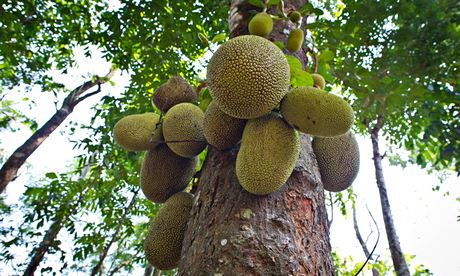
I went home and looked at what the Internet had to say about jack fruit. The first video I found showed someone cutting a jack fruit apart with a machete https://www.youtube.com/watch?v=MsafP-TDi_k  This won my heart since it would give me a chance to use my machete, which has not gotten a whole lot of use since I brought it home from Panama in 1995. Other sites stressed the heavenly taste of this fruit. This made me wish that I had purchased it. Internet experts say that it is the biggest tree fruit in the world. (Is there some bigger non-tree fruit?) The fruit can reach more than a hundred pounds on a tree up to fifty feet tall. See the pictures of the jack fruit tree and of the jack fruit that weighs 61kg (134 pounds). Getting a fruit this big to market poses a problem (see picture).


      JJackfruit or Jack Tree (Artocarpus heterophyllus), fruit growing on the tree, India


As the days passed, I continued to feel the pull of the jack fruit, perhaps because it is the only fruit large enough to generate its own gravitational field. Finally, I decided to make the financial investment and buy a jack fruit. I did not want jack fruit to show up in the ones-that-got-away e-mail that is planned.

A week later I was back at H Mart. To make an investment like this, one wants to make sure that the fruit is ripe. The Internet said that it should give to the touch like an avocado and should be fragrant. The first picture below shows the jack fruit display and me smelling a candidate for purchase. After applying my two ripeness criteria, I was still unsure. Luckily, an Indian man saw my puzzlement and came to my rescue. He squeezed the one I had been leaning toward and pronounced it overripe. He picked out one that, he said, was a day or two from being perfect. I smelled it and could not smell anything, but his wife popped up, smelled it, and pronounced it fragrant. Apparently, like Mei-Mei, she is a super smeller. She said that the jack fruit was their national fruit. With the approval of these two experts, who apparently were attracted by someone showing interest in their national fruit, I picked up the jack fruit; see the picture that shows that even a weightlifter is disconcerted by the weight of a jack fruit. I hefted it into my shopping cart; see the picture that shows my jack fruit in captivity. I was especially pleased with this particular fruit because it was the smallest for sale; the biggest weighed more than twice as much. (Later in this shopping trip, this Indian man advised me on the purchase of lychee nuts, as you read in last week's e-mail. He was a good Samaritan who could tell that I needed someone to throw me a rope.) The conclusion: Fruit exploring, like any other exploring, goes a lot better if you have native guides.

At check out, I found that my jack fruit weighed 23.43 pounds. At $1.29/lb, this set me back $30.22. My receipt trumpeted the fact that the regular price was $1.99/lb and that I had saved $16.41. I preened myself on this saving.


Two days later it was time to butcher the jack fruit. The Internet experts freak out at the white, milky, dandelion-like sap, called latex, that oozes from a jack fruit incision; they say that this latex coats your knives and hands and is impervious to soap and water. Each expert has his own measures that he advocates to combat the latex menace. I decided to set up a card table in the back yard so that if the latex went all over the place, it would foul the back yard rather than my kitchen. I covered the table with the needed items:
  • Newspaper to protect the card table from the latex.
  • Machete, cleaver, carving knife, and steak knife for the various levels of cutting that are needed.
  • Olive oil, which the experts say to slather on your hands and knives to keep the latex from adhering to them. The experts really are alarmist on this and try their best to scare you with the threat of latex.
  • Paper towels for whatever general cleaning is needed.
  • My back-up cutting board. I will use its back to protect it from the dreaded latex.
  • A copy of Scientific American, which I have finished and am ready to throw away. The experts say that slick magazine paper is the best material for wiping latex off of your implements.
  • Serving plate to pile the jack fruit on.
  • Plastic bags to put jack fruit in so I can give it away or store it in my fridge.
  • Two doubled trash bags on each side of the table. Jack fruit generates a lot of slash.
Once everything was assembled, I took a deep breath and addressed the jack fruit; see picture. To fend off the latex menace, I covered my hands and implements with olive oil. Usually, you try to keep from getting oil on yourself, but in this case the oil is the lesser of two evils.

I took my machete and cut the jack fruit lengthwise. Then I cut it into halves, fourths, eighths, and sixteenths. A sixteenth was small enough to work with. (One picture shows a close-up of half a jack fruit. Another shows a half, quarter, eighth, and sixteenth, with a fragment of the other sixteenth.) Now I faced the perennial problem of figuring out which part was good to eat and which should be thrown away, a problem that I nearly got wrong with the pomegranate. I decided that the yellow part was the good part, so I started separating it out. There were a mass of stringy fibers that held onto the yellow fruits, and it was somewhat tedious to dig out the fruits (see pictures). Each fruit was maybe an inch and a half long, three quarters of an inch wide, and a quarter of an inch deep. Each fruit held a seed. Keeping with the gestalt of this fruit, the seed was big, almost the size of a kumquat. The last picture shows the state of the card table when I had separated out five-sixteenths of the jack fruit; you can see some of the jack fruit piled on a plate and some in a plastic bag ready to be given away.

Periodically I would cut off another piece to clean. Cutting deep within the oozing insides of the jack fruit reminded me of the whale-butchering scenes in Moby Dick.

The big surprise is that my jack fruit showed so sign of latex at all. This apparently is unusual and indicates that this fruit was dead ripe. Hats off to my Indian advisors; they sure called this one right.

It took me about an hour and a quarter to separate out the yellow fruit from half of the jack fruit. After the first ten minutes, in which I learned how to do this, it was boring in the extreme. There are no pictures from the end of this process because the photographer got bored and left. I stopped after cleaning half the fruit and decided to give the remaining, uncleaned half to my neighbors. For a video of the Fruit Explorer cutting his jack fruit, see https://onedrive.live.com/?cid=eafd32a44851db10&id=EAFD32A44851DB10%21143&Bsrc=Share&Bpub=SDX.SkyDrive&authkey=%21AuQva1-Qbl_PTTA&v=3


I ate pieces while working. The jack fruit was sweet with a pleasing flavor that to me was not reminiscent of any other fruit, though others liken it to many fruits.  (Wikipedia says it tastes like a combination of apple, pineapple, mango, and banana. Perhaps fruit flavors are like colors. Just as any color can be obtained by mixing a few primary colors, maybe any fruit flavor can be obtained by mixing a few primary fruit flavors.) My main impression was of how much jack fruit I had left despite eating a good bit and giving about 20 fruits away. In fact, even ignoring the half that I had not cleaned, I had a daunting amount of fruit.

The verdict: Jack fruit has a pleasing and different taste, so this could easily be a regular part of my fruit diet, EXCEPT that it comes in such an overwhelming quantity. This is a fruit for special occasions when you have lots of hands to help and mouths to feed such as Thanksgiving or a luau.

When ripe the jack fruit falls off the tree, says http://www.npr.org/blogs/thesalt/2014/05/01/308708000/heres-the-scoop-on-jackfruit-a-ginormous-fruit-to-feed-the-world.  I advise against napping under a jack fruit tree.

Exactly what environmental pressures led to the evolution of this formidable fruit? Did it evolve to withstand some fearsome frugivore, perhaps a prehistoric fruit bat? Or perhaps jack fruit started off small and plant breeders have managed to increase its size. If so, I hope they can they transfer this gene to cherries.

A couple of days later, desperate for ways to draw down my overhang of jack fruit, I put some in my blender and made a smoothie, which I decanted into a glass. When I put the glass to my mouth, however, I found that the jack fruit was too viscous and would not flow to my mouth, so I had to eat it with a spoon. It tasted like jack fruit but had the look and consistency of baby food.

A jack fruit produces so much fruit that to avoid waste one feels compelled to eat and eat until one is sick of it. As Marx would say, this is the inherent contradiction of jack fruit.

The Guardian http://www.theguardian.com/environment/2014/apr/23/jackfruit-miracle-crop-climate-change-food-security says, "...jack fruit ... could be a replacement for wheat, corn and other staple crops under threat from climate change." This article continues, "It is easy to grow. It survives pests and diseases and high temperatures. It is drought resistant....It achieves what farmers need in food production when facing a lot of challenges under climate change." [Can you imagine driving through Iowa and seeing fields of jack fruit extending to the horizon?] Finally, "The fruit is rich in potassium, calcium and iron,... making it more nutritious than current starchy staples." One jack fruit researcher says, "It's a miracle. It can provide so many nutrients and calories--everything.... If you just eat 10 or 12 bulbs of this fruit, you don't need food for another half a day." It is speculated that jack fruit could be the key to preventing food wars, which the World Bank predicts could happen in the next decade. (This reminds me that in the eighties I read that amaranth was the food of the future. Now I mainly see it as a weed in my back yard.)

According to Wikipedia, jack fruit is an invasive species in Brazil, where marmosets gorge on it. This has allowed marmosets to expand their range; since they prey on birds, this causes declines in bird populations.
One Internet expert https://www.youtube.com/watch?v=J3FdyDBrEPA claims that Juicy Fruit gum took its flavor from jack fruit.
Your party tip is to put a new slant on old party games by playing pin the tail on the jack fruit and spin the jack fruit. If your guests are too sophisticated for this, then haul in a jack fruit and ask your guests to guess what it is. You will get guesses all over the map such as a dinosaur egg, a time capsule, a football used by the Ultimate Football League, a Richard Serra sculpture, a sea urchin that has made the transition to land, an object from the other side of the looking glass, a pod brought to earth by a UFO that contains the spores of an advance guard of alien invaders, a fossilized tear of the beast of Baluchistan, and a throw pillow. Then astound your perplexed guests by butchering it and feeding to them this improbable but indescribably delicious fruit. As a final flourish, boil down the exuded latex and fashion it into souvenir rubber bands for your guests to take home as a memento of your party.

Rick

P.S. If you read the text above carefully, you noticed that the first Fruit Explorer video has been made. The rationale for this video is that with all the perplexities surrounding this picturesque but totally unknown fruit--difficulty in cutting it, the specter of latex, the problem of figuring out what was good to eat, determining how to butcher it, and so forth--it seemed likely that there would be set-backs and blunders when I cut into it. To capture these hilarious foul-ups, a video was made of this one-time-only event. In the end, nothing went awry, but if you wish you can view the video at https://onedrive.live.com/?cid=eafd32a44851db10&id=EAFD32A44851DB10%21143&Bsrc=Share&Bpub=SDX.SkyDrive&authkey=%21AuQva1-Qbl_PTTA&v=3 

P.P.S. Below are a few more images of this charismatic fruit.