Monday, August 4, 2014

The Fruit Explorer Encounters Jack Fruit

To All,

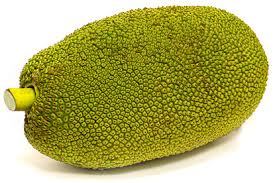
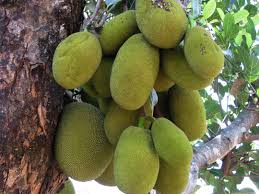
On my trip to H Mart described in the last e-mail, I stumbled across the display of jack fruit. This is one impressive fruit. It is ovaloid (see picture) and the ones on display ranged from 20 to 50 pounds. The skin is densely covered with dull spikes about an eighth of an inch long (see picture); this is reminiscent of one of those rubber mats on the counter by the cashier at a restaurant that you put your payment on. Alternatively, you can think of the exterior as covered by a bed of nails, where the nails are short and dull. Due to size and the primordial look of the exterior, the jack fruit has the aura of a living fossil from the Carboniferous. I marveled at this fruit, but, not knowing anything about it, I hesitated to spend more than $20 on a blind buy after having been burned by the sour orange.

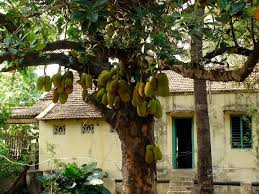
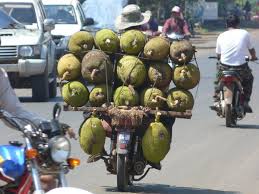
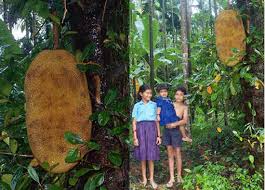
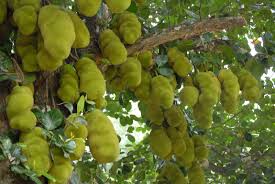
I went home and looked at what the Internet had to say about jack fruit. The first video I found showed someone cutting a jack fruit apart with a machete https://www.youtube.com/watch?v=MsafP-TDi_k  This won my heart since it would give me a chance to use my machete, which has not gotten a whole lot of use since I brought it home from Panama in 1995. Other sites stressed the heavenly taste of this fruit. This made me wish that I had purchased it. Internet experts say that it is the biggest tree fruit in the world. (Is there some bigger non-tree fruit?) The fruit can reach more than a hundred pounds on a tree up to fifty feet tall. See the pictures of the jack fruit tree and of the jack fruit that weighs 61kg (134 pounds). Getting a fruit this big to market poses a problem (see picture).


      JJackfruit or Jack Tree (Artocarpus heterophyllus), fruit growing on the tree, India


As the days passed, I continued to feel the pull of the jack fruit, perhaps because it is the only fruit large enough to generate its own gravitational field. Finally, I decided to make the financial investment and buy a jack fruit. I did not want jack fruit to show up in the ones-that-got-away e-mail that is planned.

A week later I was back at H Mart. To make an investment like this, one wants to make sure that the fruit is ripe. The Internet said that it should give to the touch like an avocado and should be fragrant. The first picture below shows the jack fruit display and me smelling a candidate for purchase. After applying my two ripeness criteria, I was still unsure. Luckily, an Indian man saw my puzzlement and came to my rescue. He squeezed the one I had been leaning toward and pronounced it overripe. He picked out one that, he said, was a day or two from being perfect. I smelled it and could not smell anything, but his wife popped up, smelled it, and pronounced it fragrant. Apparently, like Mei-Mei, she is a super smeller. She said that the jack fruit was their national fruit. With the approval of these two experts, who apparently were attracted by someone showing interest in their national fruit, I picked up the jack fruit; see the picture that shows that even a weightlifter is disconcerted by the weight of a jack fruit. I hefted it into my shopping cart; see the picture that shows my jack fruit in captivity. I was especially pleased with this particular fruit because it was the smallest for sale; the biggest weighed more than twice as much. (Later in this shopping trip, this Indian man advised me on the purchase of lychee nuts, as you read in last week's e-mail. He was a good Samaritan who could tell that I needed someone to throw me a rope.) The conclusion: Fruit exploring, like any other exploring, goes a lot better if you have native guides.

At check out, I found that my jack fruit weighed 23.43 pounds. At $1.29/lb, this set me back $30.22. My receipt trumpeted the fact that the regular price was $1.99/lb and that I had saved $16.41. I preened myself on this saving.


Two days later it was time to butcher the jack fruit. The Internet experts freak out at the white, milky, dandelion-like sap, called latex, that oozes from a jack fruit incision; they say that this latex coats your knives and hands and is impervious to soap and water. Each expert has his own measures that he advocates to combat the latex menace. I decided to set up a card table in the back yard so that if the latex went all over the place, it would foul the back yard rather than my kitchen. I covered the table with the needed items:
  • Newspaper to protect the card table from the latex.
  • Machete, cleaver, carving knife, and steak knife for the various levels of cutting that are needed.
  • Olive oil, which the experts say to slather on your hands and knives to keep the latex from adhering to them. The experts really are alarmist on this and try their best to scare you with the threat of latex.
  • Paper towels for whatever general cleaning is needed.
  • My back-up cutting board. I will use its back to protect it from the dreaded latex.
  • A copy of Scientific American, which I have finished and am ready to throw away. The experts say that slick magazine paper is the best material for wiping latex off of your implements.
  • Serving plate to pile the jack fruit on.
  • Plastic bags to put jack fruit in so I can give it away or store it in my fridge.
  • Two doubled trash bags on each side of the table. Jack fruit generates a lot of slash.
Once everything was assembled, I took a deep breath and addressed the jack fruit; see picture. To fend off the latex menace, I covered my hands and implements with olive oil. Usually, you try to keep from getting oil on yourself, but in this case the oil is the lesser of two evils.

I took my machete and cut the jack fruit lengthwise. Then I cut it into halves, fourths, eighths, and sixteenths. A sixteenth was small enough to work with. (One picture shows a close-up of half a jack fruit. Another shows a half, quarter, eighth, and sixteenth, with a fragment of the other sixteenth.) Now I faced the perennial problem of figuring out which part was good to eat and which should be thrown away, a problem that I nearly got wrong with the pomegranate. I decided that the yellow part was the good part, so I started separating it out. There were a mass of stringy fibers that held onto the yellow fruits, and it was somewhat tedious to dig out the fruits (see pictures). Each fruit was maybe an inch and a half long, three quarters of an inch wide, and a quarter of an inch deep. Each fruit held a seed. Keeping with the gestalt of this fruit, the seed was big, almost the size of a kumquat. The last picture shows the state of the card table when I had separated out five-sixteenths of the jack fruit; you can see some of the jack fruit piled on a plate and some in a plastic bag ready to be given away.

Periodically I would cut off another piece to clean. Cutting deep within the oozing insides of the jack fruit reminded me of the whale-butchering scenes in Moby Dick.

The big surprise is that my jack fruit showed so sign of latex at all. This apparently is unusual and indicates that this fruit was dead ripe. Hats off to my Indian advisors; they sure called this one right.

It took me about an hour and a quarter to separate out the yellow fruit from half of the jack fruit. After the first ten minutes, in which I learned how to do this, it was boring in the extreme. There are no pictures from the end of this process because the photographer got bored and left. I stopped after cleaning half the fruit and decided to give the remaining, uncleaned half to my neighbors. For a video of the Fruit Explorer cutting his jack fruit, see https://onedrive.live.com/?cid=eafd32a44851db10&id=EAFD32A44851DB10%21143&Bsrc=Share&Bpub=SDX.SkyDrive&authkey=%21AuQva1-Qbl_PTTA&v=3


I ate pieces while working. The jack fruit was sweet with a pleasing flavor that to me was not reminiscent of any other fruit, though others liken it to many fruits.  (Wikipedia says it tastes like a combination of apple, pineapple, mango, and banana. Perhaps fruit flavors are like colors. Just as any color can be obtained by mixing a few primary colors, maybe any fruit flavor can be obtained by mixing a few primary fruit flavors.) My main impression was of how much jack fruit I had left despite eating a good bit and giving about 20 fruits away. In fact, even ignoring the half that I had not cleaned, I had a daunting amount of fruit.

The verdict: Jack fruit has a pleasing and different taste, so this could easily be a regular part of my fruit diet, EXCEPT that it comes in such an overwhelming quantity. This is a fruit for special occasions when you have lots of hands to help and mouths to feed such as Thanksgiving or a luau.

When ripe the jack fruit falls off the tree, says http://www.npr.org/blogs/thesalt/2014/05/01/308708000/heres-the-scoop-on-jackfruit-a-ginormous-fruit-to-feed-the-world.  I advise against napping under a jack fruit tree.

Exactly what environmental pressures led to the evolution of this formidable fruit? Did it evolve to withstand some fearsome frugivore, perhaps a prehistoric fruit bat? Or perhaps jack fruit started off small and plant breeders have managed to increase its size. If so, I hope they can they transfer this gene to cherries.

A couple of days later, desperate for ways to draw down my overhang of jack fruit, I put some in my blender and made a smoothie, which I decanted into a glass. When I put the glass to my mouth, however, I found that the jack fruit was too viscous and would not flow to my mouth, so I had to eat it with a spoon. It tasted like jack fruit but had the look and consistency of baby food.

A jack fruit produces so much fruit that to avoid waste one feels compelled to eat and eat until one is sick of it. As Marx would say, this is the inherent contradiction of jack fruit.

The Guardian http://www.theguardian.com/environment/2014/apr/23/jackfruit-miracle-crop-climate-change-food-security says, "...jack fruit ... could be a replacement for wheat, corn and other staple crops under threat from climate change." This article continues, "It is easy to grow. It survives pests and diseases and high temperatures. It is drought resistant....It achieves what farmers need in food production when facing a lot of challenges under climate change." [Can you imagine driving through Iowa and seeing fields of jack fruit extending to the horizon?] Finally, "The fruit is rich in potassium, calcium and iron,... making it more nutritious than current starchy staples." One jack fruit researcher says, "It's a miracle. It can provide so many nutrients and calories--everything.... If you just eat 10 or 12 bulbs of this fruit, you don't need food for another half a day." It is speculated that jack fruit could be the key to preventing food wars, which the World Bank predicts could happen in the next decade. (This reminds me that in the eighties I read that amaranth was the food of the future. Now I mainly see it as a weed in my back yard.)

According to Wikipedia, jack fruit is an invasive species in Brazil, where marmosets gorge on it. This has allowed marmosets to expand their range; since they prey on birds, this causes declines in bird populations.
One Internet expert https://www.youtube.com/watch?v=J3FdyDBrEPA claims that Juicy Fruit gum took its flavor from jack fruit.
Your party tip is to put a new slant on old party games by playing pin the tail on the jack fruit and spin the jack fruit. If your guests are too sophisticated for this, then haul in a jack fruit and ask your guests to guess what it is. You will get guesses all over the map such as a dinosaur egg, a time capsule, a football used by the Ultimate Football League, a Richard Serra sculpture, a sea urchin that has made the transition to land, an object from the other side of the looking glass, a pod brought to earth by a UFO that contains the spores of an advance guard of alien invaders, a fossilized tear of the beast of Baluchistan, and a throw pillow. Then astound your perplexed guests by butchering it and feeding to them this improbable but indescribably delicious fruit. As a final flourish, boil down the exuded latex and fashion it into souvenir rubber bands for your guests to take home as a memento of your party.

Rick

P.S. If you read the text above carefully, you noticed that the first Fruit Explorer video has been made. The rationale for this video is that with all the perplexities surrounding this picturesque but totally unknown fruit--difficulty in cutting it, the specter of latex, the problem of figuring out what was good to eat, determining how to butcher it, and so forth--it seemed likely that there would be set-backs and blunders when I cut into it. To capture these hilarious foul-ups, a video was made of this one-time-only event. In the end, nothing went awry, but if you wish you can view the video at https://onedrive.live.com/?cid=eafd32a44851db10&id=EAFD32A44851DB10%21143&Bsrc=Share&Bpub=SDX.SkyDrive&authkey=%21AuQva1-Qbl_PTTA&v=3 

P.P.S. Below are a few more images of this charismatic fruit.


Thursday, July 31, 2014

The Fruit Explorer Encounters Lychee Nuts

To All,

For months the Fruit Explorer has been fantasizing about going to H Mart, the Korean supermarket that is known for exotic fruits. Dreams do come true, and, prompted by Mike, I finally decided to undertake a journey and travel to Burlington. As I entered the fruit section, I immediately saw a sign for lychee nuts. I first learned about them from Mad Magazine when I was in the eighth grade and have been red hot to try them ever since. My opportunity had arrived. (The preferred spelling in the Third New International is "litchi," but I will go with H Mart's spelling. The first syllable, which is accented, can be pronounced as "lie" or "lee." It is a fruit rather than a nut, but I will follow the traditional usage.)

An Asian woman was standing at the lychee bin and furiously sorting through a huge pile of nuts (see picture), quickly examining and discarding them. The nut was roughly round, about an inch across, with a tough, pebbled exterior that looked like armor plating. I was totally unsure how to judge ripeness, so I asked her what to look for. There was such a look of baffled uncertainty on my face that she intuited that I was new to this nut; to bring me up to speed, she showed me how to peel one so that it was sitting on a little pedestal of peel and offered it to me. I took it and ate it. Meanwhile, Mike, who denounces me as a disgrace to civilization when I eat a test grape at Market Basket before buying, was watching, horrified. It turned out, however, that there was a trash can right by the lychee bin, and it was filled with discarded peels. Even Mike saw that the store had placed the trash can there and that it expected shoppers to try out the nuts. He concluded that mores are different in Korean grocery stores, and he accepted the rightness of sampling at H Mart. This is the latest proof that travel is broadening.

The woman told me that the little white patches that looked like nascent mold made no difference. I aped her method and sorted furiously through the pile, though the nuts all looked the same to me, and randomly picked out ten. On a second visit to H Mart a week later, an Indian man saw me sorting through the lychee nuts, and he volunteered advice. He said there should be some red left; avoid the ones that are all green. Avoid them if they are too soft. Pick the bigger ones. Root around in the bottom of the bin where the best nuts tend to be. He demonstrated by digging down and making the nuts fly; I now understood the technique of the Asian woman. (This Indian man was quick to offer me advice since a few minutes before he had advised me on another fruit, as you will read in the next e-mail.)

At home the big moment to experience lychees had finally arrived. I had watched the woman peel one but was unsure about how to proceed. I found that the tough look of the peel was deceptive; the touch of a thumbnail easily broke the armor plating, and it peeled right off with no problem. This left a soft, white, moist, slippery fruit, which I popped into my mouth; see picture. It was very sweet and had an unusual but pleasing taste. There was a pit in the center that needed to be spit out; see picture. I quickly made my way through all ten and would have eaten more if available. (The pits in my nuts were much smaller than the ones pictured. Also, my nuts were mainly brown with a bit of green rather than red like in many of the pictures.)

The verdict: If, like me, one craves sweetness, then this fruit is a winner. At about twelve cents per nut, this fruit will not break the bank.

Your party tip takes advantage of the fact that one can peel the nut without touching the meat so that there is just a little pedestal of peel that one can use as a handle; this means that one person can peel and feed a lychee nut to another in a fully hygienic way. Here's what you do. Teach all your guests the hygienic way of peeling a lychee nut. Have everyone sit around the table and blindfold everyone except your self. You start by peeling a nut and and feeding it to someone. You say nothing, so, while others probably hear the smacking noises and know that a feeding is going on, no one else knows who is being fed. You put your blindfold on, ring a bell that you have put in the center of the table, and the person who was just fed takes his/her blindfold off, peels a nut, feeds one of the blindfolded guests, puts his/her blindfold back on, rings the bell, and the cycle continues. Since the person who is fed does not take his/her blindfold off until the feeder is back in place and blindfolded, no one ever knows who is doing the feeding (except for the initial feeding). The party game continues as long as the lychee nuts last. There is an air of mystery due to the anonymity of the feeders, and each person, whenever fed, can only imagine who the feeder is. Plus, anything is fun that involves blindfolds.

See the next to last picture for an example of lychee art. If the Museum of Fine Arts can do a quilting exhibition, surely it can justify an exhibition of lychee art.


Thursday, July 24, 2014

The Fruit Explorer Encounters Kumquats

To All,

Market Basket's latest surprise is kumquats. The kumquat is bright orange, egg-shaped, and about the size of a pecan; see pictures below. The kumquat was in the genus Citrus until a splitter came along in 1915 and moved it into its own genus. (Note: Taxonomists who like to divide closely related organisms into multiple taxonomic categories are called splitters; those who like to combine them together into a single taxonomic category are called lumpers. The divide between splitters and lumpers is almost religious. I am a lumper, and I despise splitters, who in my view are insensitive to the variability in natural populations. For this reason, I consider a kumquat to be a citrus fruit.) I paid $3.50 for a pint, which was about 20 kumquats.

The YouTube video on how to eat a kumquat https://www.youtube.com/watch?v=z0nK5zXMDDc only lasted 46 seconds. This is the shortest fruit video I have seen, thus indicating that this is the fruit for those who crave simplicity. The technique is to wash, pick off any remaining stem, roll it around to crush it a bit (to release the essential oils, according to the experts), eat it whole, and swallow or spit out the seed(s).

With these instructions fresh in my memory, I washed, picked, rolled, and ate. There was initially an almost shocking burst of tartness, I found that if I chewed through this, then after a couple of seconds the tartness was replaced by a pleasing citrus taste. I ate eight or ten of them. 

My kumquats each had from zero to three seeds. Each seed had the look and size of an orange seed; see picture below.

I also tried a peeled kumquat. If you roll it around and crush it well, you can cut off one end and peel it in about 20 seconds. I found that this dialed down both the burst of tartness and also the flavor. Peeling this fruit, however, destroyed its simplicity, which is its hallmark, so I don't plan to peel my kumquats in the future.

Needless to say, people go ape over the nutritional properties of kumquats, e.g., http://www.nutrition-and-you.com/kumquat-fruit.html.

The verdict: While I am a fan of citrus fruit, and while I like the taste of kumquat, the initial blast of tartness was too much. Kumquats are like cherry bombs--small but strong. Oranges are both better and cheaper. For me, the kumquat will be nothing more than a very occasional change of pace. I can see, however, how this fruit could appeal to those who seek zest.

Seven hours after eating the kumquats, I could still taste them. I gave away the half-pint that remained.

Your party tip is suggested by kumquats looking like little Easter eggs. Before your guests arrive, hide a dozen kumquats around your home. After people have had a few drinks, announce that they are going on a kumquat hunt. As the hunt proceeds, some will exult as they find and eat kumquats. (Your guests will take deep satisfaction in enacting the ancient human rite that you eat what you kill.) Those who are shut out will become increasingly agitated, and when there are only a couple left, their frenzy will build until they are tearing your place apart as they frantically search for a kumquat. After the party, you can use the level of carnage and destruction as a measure of the quality of your party. Perhaps songs will be written celebrating your orchestration of the great kumquat hunt.

Note to gluten avoiders: Kumquats can be used to make a gluten-free flour.

Note to connoisseurs of gracious living: Add class to your drinking by substituting a kumquat for a twist or an olive in your martini.


Thursday, July 17, 2014

The Fruit Explorer Encounters a Sour Orange

To All,

While skylarking through Market Basket I happened upon a sour orange, which I don't think I had ever heard of. Once at home with my prize, I went to https://www.hort.purdue.edu/newcrop/morton/sour_orange.html to see what this fruit was all about. I was taken aback to read, "The normal types of sour orange are usually too sour to be enjoyed out-of-hand." Uh-oh. I might have misfired on this one. This article goes on to say, "The greatest use of sour oranges as food is in the form of marmalade and for this purpose they have no equal." Further reading revealed that this fruit is a soap substitute. A further bad sign is that there are no You Tube videos on sour oranges; not even the fruit apologists have a good word for this fruit.

Needing to go further afield than usual to find information, I found that WebMD has quite a bit to say about the sour orange at http://www.webmd.com/vitamins-supplements/ingredientmono-976-BITTER%20ORANGE.aspx?activeIngredientId=976&activeIngredientName=BITTER%20ORANGE. It is used to treat fungal infections like ringworm and athlete's foot. The folk medicine types "...use bitter orange flower and its oil for general feebleness, 'tired blood' (anemia), impurities of the skin, hair losscancerfrostbite, and as a tonic." Moreover, "In aromatherapy, the essential oil of bitter orange is applied to the skin and also inhaled as a painkiller." Returning to the sober side of medicine, it says, "Before taking bitter orange, talk with your healthcare professional if you take any medications. It can interact with many drugs....Bitter orange has many chemicals that affect the nervous system. The concentration and effect of these chemicals can change depending on the part of the plant and the method used for preparation. These chemicals can squeeze blood vessels, increase blood pressure, and cause the heart to beat faster." There is the further curious information: "Because the fruit is so sour and bitter, it is rarely eaten, except in Iran and Mexico."

Well, maybe my sour orange is not the "normal" type. Maybe it will be tasty. I peeled it like a regular orange, popped a wedge in my mouth, and made a series of cartoon faces as I was assailed by the most penetrating sourness intertwined with a full bouquet of disgusting flavors. It's even worse than the gunk you drink before a colonoscopy. Perhaps this is what an unripe persimmon tastes like. I hurriedly threw the remainder in the garbage and was glad to be quit of this repellent fruit before it had a chance to squeeze my arteries. I guess you have to expect contretemps like this when you explore among the off-brand fruits.

That is a dollar and a half down the drain.

I am at a loss why Market Basket would stock such a fruit. Surely there are not that many enthusiasts of homemade marmalade or practitioners of aromatherapy..

The verdict: A basket of sour oranges is what you give someone that you don't like but to whom you are forced to give a present.

The party tip is to hide the sour oranges before your guests arrive.

The main lesson from this fruit is that one should not take WebMD seriously. The remaining question is what is wrong with the people of Iran and Mexico.

We'll see if any of you spring to the defense of the sour orange.

Saturday, July 12, 2014

More Fruit Explorer Miscellany


I have just learned that there is a Fruit of the Month Club. I do not plan to join it. The Fruit Explorer would prefer to go on safari through Market Basket, Stop&Shop, and Trader Joe's rather than be the passive recipient of some pre-packaged fruit. Here we have an example of the proverb that one does not go on safari from one's recliner.

You have read of my disenchantment with the ataulfo mango, and you have read of one unhappy experience with an unripe standard mango. I have two more encounters with a standard mango to report. First, I had a fruit salad with standard mango prepared by Maria, the mango whisperer. The mango in the salad did not appeal to me though everyone else was raving about it. Second, Mei-Mei gave me a perfectly ripe mango. It was orangeish yellow with a big red splotch and not a trace of green. I cut off a slice, scored it, and flexed it inside out. (I have mastered the technical aspect of eating a mango.) I chowed down, and found that I didn't much care even for this perfect mango. It finally occurred to me that mango has much the taste and texture of a peach, and I have never cared much for peaches, so I now understand why my reaction to mangoes differs from everyone else's. The final word: Mangoes of any stripe do not speak to me.

You will recall my starter garlic press from Target. Well, its handle fell off. I can stick the handle back on and press the garlic just fine, but the handle falls off again when it leaves my grip. Clearly, it is time for me to add a second garlic press to my collection.

I needed shampoo, and browsing the aisles at Dollar Tree I saw one with the impressive title, Alberto VO5, Herbal Escapes, Kiwi Squeeze. I figured that kiwis have earned a larger place in my life, so I bought a bottle. This is a reminder that fruit is for more than eating. I wouldn't be at all surprised if some fruit turned out to provide the cure for cancer. (Have I carried my enthusiasm for kiwis too far? Does kiwi really belong in shampoo?)

What is happening to our crops? My favorite fruit is the large navel orange. Traditionally, they are available from mid-January until late April. This year, I started finding good ones in mid-December. On July 8, I went to Trader Joe's, and they were still being sold. Thinking that this might be the last batch of the season, I bought eighteen. When I open my fridge, it looks like there is an orange tree inside.


In reading about the various fruits, one invariably encounters the statement, "high in vitamin C." This property of fruit, however annoying to read over and over, has significance in the evolution of the human species. It is a fact that our pre-primate ancestors had the ability to synthesize vitamin C. Therefore, they never had to worry about vitamin C deficiency or scurvy. When the early primates evolved, they specialized in eating fruit. Because fruit was so high in vitamin C, they did not need the ability to synthesize their own. Since evolution follows the use-it-or-lose-it philosophy, they lost the ability to synthesize vitamin C. Humans still have the genes for synthesizing vitamin C, but they have been mutated into uselessness. Now that we no longer specialize in fruit and sometimes do have trouble getting enough vitamin C, you might curse our early primate ancestors for fumbling away this valuable physiological capability. Not so fast. It is thought that the ability to spot fruit and to distinguish ripe from unripe fruit led the early primates to develop color vision, which their ancestors did not have. Therefore, the fruit-eating lifestyle of early primates led to the loss of the ability to synthesize vitamin C but also to color vision. I would say that our early primate ancestors made a pretty good trade-off. I tip my hat to them.

Saturday, June 28, 2014

The Fruit Explorer Encounters a Fuyu Persimmon

To All,

Stop & Shop provided me with a fuyu persimmon (hereafter "fuyu"), which looks like a small, dark orange tomato (see picture). One of the things known from reading Mark Twain is that persimmons are overpoweringly and unforgettably sour if eaten before they are ripe. For advice on judging ripeness, see https://www.youtube.com/watch?v=VzqQ_oFXPhE I let my fuyu sit on my kitchen window sill for a week until it was a little bit soft.

It turns out that you can eat this fruit in just about any way. To see what different experts recommend, see  https://www.youtube.com/watch?v=xBEAwZ2kCa8 or https://www.youtube.com/watch?v=bZLS2mPcGCA or other videos readily found on YouTube. The former video claims that the ancient Greeks called the fuyu the fruit of the gods.

The fuyu has an especially prominent stem attachment (see picture). It's not as bad as the pineapple, but it surpasses most. To get it off, I turned the fuyu upside down and cut it vertically so that the attachment was all that was holding it together. Then I tore the two halves apart as if I were ripping a phone book in two. (Luckily, all of my readers are old enough to understand this analogy.) This removes the attachment from one half, and you can then easily tear off the other half. I then cut the fuyu into segments.

First going with the camp that considers the peel bitter and to be avoided, I pared the peel away from half the wedges and ate them. My first sensation was a wave of relief that I tasted no sourness; I had avoided the rookie mistake of eating an unripe persimmon. I then concentrated hard on the taste and discovered that there was none. None at all. This fruit is all texture. I must say, these are some very undemanding gods. Next going with the camp that considers the peel a piquant addition to the fuyu's flavor, I ate the rest of the wedges with the peel on. I could discern no difference.

If you slice a fuyu like a tomato, you will encounter some found art; see picture.

The verdict: This fruit was a real letdown. It turns out that I got this fruit at the very end of the season, so my theory is that I got a senescent one that had lost its vigor. I will try again next year, and I trust that I will then discover that it is indescribably delicious.

Now for your party tip. First serve your guests a platter of unripe fuyus. You can use each guest's reaction to judge his/her innate courteousness. Some will make forced, polite comments, whereas others will erupt in expostulations such as, "What is this crap?" Then, after making sure that it is the peak of fuyu season, bring out a platter of ripe fuyus. As your suspicious guests gingerly try them, watch the jeers turn to cheers as they shower you with hosannas for introducing them to such a divine fruit.

This is one fruit that clearly was named not by a marketeer but by someone with bad attitude.

Wednesday, June 11, 2014

The Fruit Explorer Eats an All-fruit Lunch

To All,

I decided to try an all-fruit lunch and see how it turned out.

First, I cut up a whole pineapple and ate about a quarter of it. (I have long been eating pineapples and do not consider them exotic, so they will not be treated in this series.) The only problem with pineapples is disposing of the top, which is large and spiky. It takes up almost an entire trash bag, and if you need to reach into the bag to retrieve something, you are likely to get stabbed.

Second, I ate another ataulfo mango. This was my third encounter with this fruit; you have already read about the first two unsatisfactory encounters. This mango was given to me by Mei-Ling, and this batch of mangoes had already been certified as primo by that gastronome extraordinaire, Mei-Mei. It appeared to be perfectly ripe. I cut a slice, scored it, turned it inside out, admired the presentation, and ate it. Sadly, I was indifferent to it. 

Third, I had that workhorse of fruit, the banana. Again, this fruit is not exotic and I don't plan to report on it. (I will note that back in the eighties, wondering about the truth of the cliche that banana peels are slippery, I designed an experiment. I went out into the parking lot of the Civil Air Terminal at Hanscom Field, put a splayed banana peel on the pavement with the inside part facing down, and gingerly stepped on it. I found it to be slippery in the extreme. Cliche confirmed.)

Fourth, I was going to have an orange but decided not to since I was full. I prize the large navel oranges, and they are my staff of life for four months a year, but we are at the end of the season, so I decided to conserve my dwindling stock and not pile yet more fruit into this meal.

The verdict: Though full, I found an all-fruit meal to be unsatisfying. I guess I would not have been a success as an early primate. Henceforth, I will use fruit as a side dish, dessert, or midnight snack.